Category Archives: Ancients

Mortem et Gloriam Ancient rules

Mortem et Gloriam is Si Halls new set of ancient rules. Its been in development for over a year now, and the Challenge was the last beta test tournament before go live in July. The Challenge was set as 2 days, with the first day with the release lists (Dominance of Greece and Roman – book 2 in old money) , the 2nd day being ‘open’ to test some of the newer test lists and test the rules to destruction with some really anachronistic match-ups.

The rules themselves have some familiar concepts and some new ones too. The command and control is via a shared deck of cards. A card will be of 1 of 5 colours indicative of a ‘quality’. The better cards being rarer as you might expect. The players share the same deck. Each turn cards are dealt to each command depending on the generals rating. These cards can be spent in a number of ways. They can spent to move, bolster troops, prompt charges etc. So the is definitely a hand management aspect of the game. Troops are moved by alternate activations so IGOUGO but only by spending cards. This is a neat mechanism as both players are engaged in each turn. There are mechanisms to allow delaying actions and there are good reasons to move first and pin enemy troops in place and going 2nd to react to what your opponent is doing. So this is more ‘euro game’y than what you would expect in a traditional wargame.
The armies are based in units but combat is done on a file by file bases. Each troop type generate a set of advantages going up and down a colour ladder similar to the cards – black,white,green,yellow ,red (from worst to best). There is a set of combat dice also in these colours. These dice have 4 options. Kill a base, Wound (1/2 a kill), Special & nothing (blank). The higher up the ladder the more likely you are to get a result. Specials are a neat idea as it allows some effect that some troops might have. The S results count in both close combat and shooting, so an S for archers would be a ‘slow down’. So in what happens is that you might declare a charge against bowmen, as a response they shoot if they score enough ‘S’s then you deduct a distance from your charge (and maybe not make it into combat). In combat Hoplite have a ‘Shove’ special rule, so if they get a ‘S’ in close combat then the adjacent file gets a boost as the spearmen push into the ranks of the enemy. Warband have a ‘Shatter’ special rule … you get the idea.
For my day 1 list I took Slave revolt. Si had asked for this competition to use larger size armies than normal to extent the runtime to allow other competitors to see the games in action. The Slave revolt was enormous, and I had to draft in some proxys!

Here is what the list looks like

Slave list
Game 1 was against Sassasian, played by Bob
I’d played Bob the week before with this army so I had a good idea what to expect. The pre pattle phase consists of an attack/defend rolloff (using the coloured dice based on the quality of the general), whoever wins this gets to pick whether to attack or defend. The defender then picks the region. There is a map, and which is basically a matrix of terrain types, so closed flanks on one vertices and density of terrain on the other. The defender picks a start position on this map (which is dictates by his geographical region), then cards are dealt. The number of cards depends on your generals. 5 hands are then played. The winner of each hand gets to move the place on the map so you might wish to try to head towards the coast and get a secure flank. During this phase you may will to hold onto better cards if you don’t care about the terrain so much. Once the final position on the map is decided the terrain is generate (ie whether there is secure flank – coast , mountain etc), and the amount of pieces of additional terrain. Once the table terrain is set up you move onto the scouting phase. So cards are dealt based on generals and the number of horses you have in your army (you make have kept cards from the prior phase if you thought that scouting is more important than terrain). Each hand is shown – and an outscouting percentage is calculated. For these each card has a value – green 10, yellow 20, red 40. The delta between the two hands is the ouscouting amount and by how much (as an army percentage). So even if you attack you make get oustcouted and have to deploy first.

game1


These are not good cards

The Sassanids chose to attack and while Spartacus being a legendary general had a lot of cards, they weren’t very good, but we did manage to hold onto a secure (mountainous flank). There was only one other piece of terrain as the Persians are wangled their way from a dense terrain situation to an open one.
The game itself was one of attrition. The slaves by and large are of a poor quality but you get big units and a lot of them. All units break on the same amount 50% , so you can try to play the numbers by your trying to keep rolling enough dice to kill your smaller opponent. The Sassanids had a robust centre of cataphracts and elephants, and this proved a hard nut to crack. As they all have shove and generally a better factor as long at they throw OK they prevented me from much of chance of killing much (in game terms if they ‘shove me’ my dice goes from white to black, and the chances of getting a result then is much reduced)
That said it was hard for the Persians to whittle down so many bases, and the slaves did have some success working the flanks
The result was a loss – albeit not an army break
Game 2 – Classical Indian played by Dave.
We made a couple of errors in this game on the interactions that really messed up this game. As such it made the Indian Elephants far more fragile than they should have been. Hopefully this will be clarified on the QRS 

game2
As a result of this the elephants were destroyed too quickly and ended up as a big Slave victory
The scoring mechanism is neat too, as you score for units that you destroy. So defensive play where players risk little will result in a smaller score.

Game 3 – Late Republican Romans played by Bren
Day 2 was the open period and I picked Libyan Egyptian as they have been languishing in a box for a long time since I stopped playing FoG:AM.

game3
The Roman army was tiny, but they have a couple of special rules. These being Shield Cover, and Melee expert. The game open up well as the Chariots swept down one flank and destroyed the single unit of Roman cavalry. However, the army was mostly legionary types, and the end of the end went into shield cover (with a reduced movement capability). This negated a lot of the chariots shooting and where we did get some wounds Bren managed his hand to always rally these back up. The centre advanced on and while it got stretched when it got to the Egyptian foot it was rather like a hot knife through butter. I made a mistake with the Mesh Wesh, who are great ‘charging’ types, but my movement meant I couldn’t take advantage of that and in a protracted fight with Legionaries they are dog meat.
Big loss to the Romans
Game 4 – Lithuanian played by Paul.
I’ve not played any of the medieval stuff yet and this was an eye opener. Paul had a mostly mounted force with a centre of war wagons and bombards. His plan was to come forward and drop back luring me towards the shooting centre. In the rules its reasonably easy for mounted troops to go backwards as well as forwards. I rather fell into the trap and found that bombards against chariots its not great! The Egyptians gave a reasonable account of themselves with a heroic charge by the Mesh Wesh sweeping away some Slavic foot and looting the camp.

game4
Looting the camp has a rather neat effect. Once destroyed each unit in the army has to take a test or lose a base – simulating the morale effect on seeing the baggage lost)
This did have some potential with some key units on the Lithuanian side only 1 base from breaking – Teutonic knights, I’m looking at you. However they passed those tests and the Libyans were consigned to utter defeat.
Hope that have given a flavour of these rules. I’ve been enjoying them. The main reason it they are quite different to what has come before. Sure, they have elements that feel more like a board game, but compared to its derivative peers that are currently doing the rounds, if feels more like a breath of fresh air.

https://www.facebook.com/mortemetgloriam/

http://thewargameszone.freeforums.org/index.php

They are out in July , and the site & forum are active and Si is keen to get all involved.

Looking forward to Britcon and first tournament!


BADCON 2016

badcon2016

21st BURTON UPON TRENT 20th & 21st February 2016
Wargames Weekend The Town Hall
Burton upon Trent
DE14 2EB

You are invited to come and join us for our 21st annual competition weekend and play one of the following;

DBMM Doubles
500 points any book 3000BC—500BC.
£30.00 per team

FOG Ancients Doubles
900 points any book 500BC—500AD.
£30.00 per team

FOG Renaissance Doubles
900 points any book 1571AD—1621AD.
£30.00 per team

Renaissance special rule- Any heavy artillery used must be the first battlegroup(s) deployed, followed immediately by any medium artillery used.

Art De La Guerre Doubles
400 points any book 500BC—500AD.
£30.00 per team

ADLG Special rules;
1. 400 points made up of 2 x 200point armies. Each army must not be more than 210 points with a combined total of no more than 400 points.
2. The armies chosen must be listed as potential allies in either army list. All troop options from both lists must be available within the time period 500BC—500AD.
3. Commands from each 200 point “army” may be mingled at deployment. Each player must command the 3 adjacent commands in their “half” of the table.
4. The break point of the army is the combined total of both armies.
5. If flank marching or ambushing 1 command it is permitted to start with 2 commands for one player and 3 for the other player and then transfer one command to maintain the 3+3 requirement once the flank march arrives or ambush is revealed, in order to disguise the flank of arrival. In the same principle, if only one flank march/ambush is being attempted, either player may roll for the flank march/ambushing command.
6. Each player has a separate standard camp that must be deployed in their half of the table. The loss of each camp counts as per the standard 200 point rules.
7. Teams are expected to roll for and move 2 commands (ie 1 command per player) simultaneously in order to not unduly delay play and to resolve combats together as well where possible.

Entries and lists for all competitions to dgreen@green2004.fslife.co.uk

Cheques payable to BURTON AND DISTRICT DBM

To Dene Green
19 Rosecroft Gardens
Swadlincote
Derbyshire
DE11 9AF

Battle of Clontarf

Battle of Clontarf Weir 23rd April 1014 was a pivotal event in Irish history as it saw the end of a dynasty following the deaths of 3 generations of Brian Borus‘ family, so despite being victorious on the day the power of his lineage was broken.

contarf6
The forces that faced each other that April morning on the northern bank of Dublin Bay was a veritable mix of different Irish tribes with ever changing loyalties, one of Brian’s supporters even withdrew his support on the morning before sensing a defeat for the rebels and so changed his allegiance back again, Vikings from The Orkneys and Isle of Man and even a few English and Scots.

contarf4
The army of Brian Boru occupied the higher ground and had a very slight numerical advantage, the rebel army of Dubgall mac Amlaib had to attempt to stop Brian’s army from garnering even more support, to this end the armies moved towards each other shortly after 7am in the morning.

contarf3
The rebel army placed a small force of troops commanded by Sitric Silkenbeards son on its left flank, approximately 2000 men from Leinster in the centre and on its right flank were the Vikings from Orkney and Man. A force of some 1000 men remained in Dublin commanded by Sitric Silkenbeard who watched the fight without getting directly involved.

contarf2
Facing the rebel army was a force made up of Vikings and other mercenaries on the right flank, followed by contingents from Connactht and Munster with the left flank being held by Brians son Murchard and most of the Royal troops.
The two armies clashed all the way along the lines with no quarter asked for or given.

contarf1
During our refight the left flank of the rebel army was soon in flight thanks to a whole series of appalling dice rolls by Roger, coupled with the advantage of higher ground.
In the centre Pete wasn’t having it any easier as he was having to combat not only the slope but also the demon dice of Lynette. Finally on the right flank Steve was having a bit more success with the Vikings against Murchard Boru.
Unfortunately Brodir of Man soon fell under the axe swing of an Irish nobleman and shortly afterwards both the Orkney Vikings and the Man Vikings were running back to their longships, only to find them scattered by the incoming tide.
So it soon became obvious that the rebel army was utterly defeated, however unlike in history only 1 general had been lost in the process.
As a historical refight the end result was he same, with the exception of a lack of dead generals, however I think the effect of the terrain would be something I would try and reduce next time.
Many thanks to all 7 players that joined in especially those brave rebels who suffered at the hands of those all too fickle dice gods.

Inaugural UK L’Art de la Guerre Tournament results

ADLG Day Sunday 8th of February

Results

Name Army Rd 1 Rd 2 Rd 3 Total Position
Alasdair Harley Hellenistic Greek 96 96 41 233 1st
Sebastien Mithradatic 96 93 41 230 2nd
Simon Clarke Spartacus 41 95 93 229 3rd
Brian Holmes Classical Indian 96 17 94 207 4th
Geoff Punshon Early Carthaginian 45 45 97 187 5th
Dave Fairhurst Late Imperial Roman 45 45 93 183 6th
Linda Fairhurst Palymran 39 94 41 174 7th
Tim Porter Late Imperial Roman 36 91 41 168 8th
Andy Finkle Alexandrian Macedonian 42 95 17 154 9th
Clive Mcleod Numidian’s 94 14 13 121 10th
Simon Le Re Mayer Early Imperial Roman 41 16 43 100 11th
Mark Clarke Early Imperial Roman 14 43 43 100 11th
Dave Saunders Alexander the Great 36 46 17 99 13th
Jesse Schoor Syracusan 14 37 47 98 14th
Matthew Scott Classical Indian 43 15 40 98 14th
Peter Card Early Successor 14 37 34 85 16th
Ray Boyles Early Imperial Roman 16 19 38 73 17th
Andy Scott Classical Indian 43 15 13 71 18th

Competiton rules were

Competition Rules : 200 point armies with standard sized 200 point tables of 120cm x 80cm. Players must bring their own terrain pieces

Lists to be drawn from either Classical Period or Roman Period army lists – From Rise to Fall, Rome : 503 BC- 476

Escape from Aliso – Germania scenario

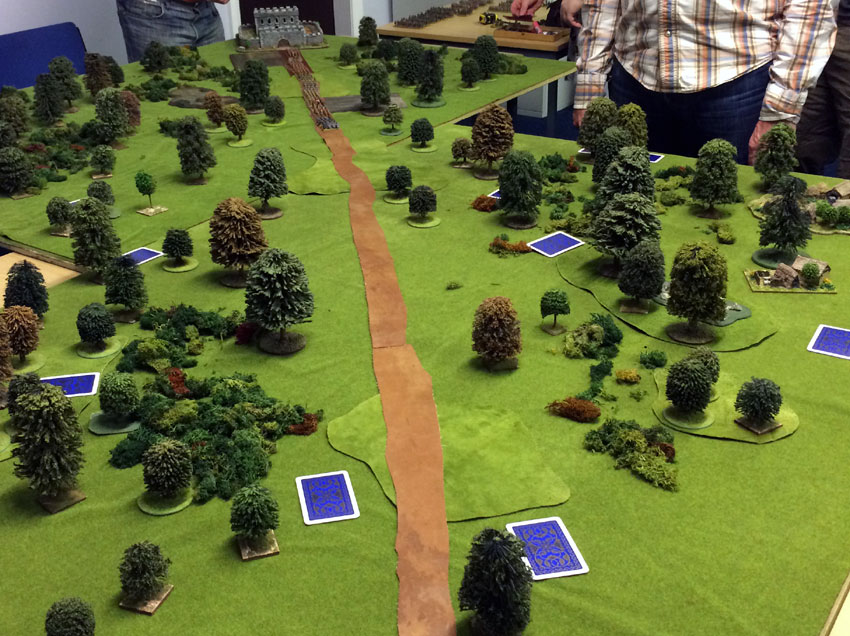
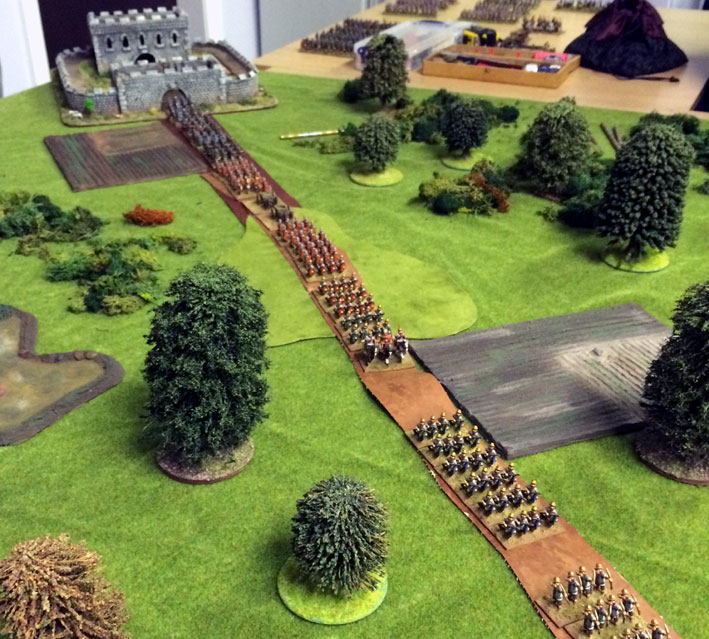
Today we played out our 2nd game in the Germania mini campaign. This time it was the escape from Aliso. After being besieged the Romans realise there isn’t much hope of holding out in hostile territory and try to break out under the cover of darkness. The scenario was based on the Warlord games Germania supplement. Our game followed the following format.

The Romans deployed in column leaving the fort.

Leaving-Aliso

The Germans has 4 forces. Each represented by a playing card deployed in ambush. There were another 6 cards that were ‘dummies’.

german-positions

After the Germans had played all the Cards then (knowing where the their deployment was) the Romans players got to exchange 2 cards and move 3 to add a it of fog of war, simulating the confusion of manoeuvring at night. When a roman units got to within 8” the card would be revealed and troops deployed if necessary. Once deployed there was further random event to represent the drifting away of the German tribe during the siege. For each units a dice was rolled , on a 6 they vanished into the dark thinking better of it. On a 1 they were poorly motivated (or drunk), for these we treated them as poor troops. So 33% of each units having some adverse effect.

roman-column

There were some house rules. The Romans were allowed to always do a march move while in a single wide column. With a general they could do at 3rd match move too. The goal of the Romans was to escape and all their victory points would come units leaving the table from the furthest road exit. A tough assignment.

marching-on

The whole table we treated as uneven, with a few patches of clear space and few patches of denser wood. This was in an attempt to balance the fact that in FoG:AM barbarian warriors don’t have much of chance against the legions. (Uneven gives HF disorder). All the Germans were classed as MF. All troops were average, apart from a couple of units of veteran legionaries.

The forces were –

Germans
24 Battle groups of German warriors each with 12 bases
Romans
18 battle groups of Roman Legionaries each with 6 bases
3 battle groups of Veteran Roman Legionaries each with 4 bases

One further random event was , if the Ace of Spades was uncovered panic set in amongst the Romans ranks. Each units must dice , on 6 they too would disappear into the woods thinking they could slip way without anyone noticing .

first-ambush

Of the events, 3 German units were made poor, and another 3 removed. The Ace was revealed and the Romans disastrously lost 5 units to rolls of 6. Critically 3 units right in the centre

When the fighting began it seemed that the Romans had no will to fight (dicing terribly) but the Germans troop quality help then out. When time was called the Romans had lost 5 Bgs and 2 civilian units. The Germans has lost 5 in the battle. The game scoring meant that the Germans got points equal to the difference in BG casualties. So 3 points. The Romans didn’t get any off table (3 pts each)… so a 3-0 if that means anything. It seemed like a narrow victory to the Germans.

surrounded

Interesting playing Hail Caesar the players had a far more easy going approach to the game. When playing FoG:AM which is normally the standards for ‘pick up’ or competition games it felt a little more tense. With a lot of random variables there was a lot of cursing and gnashing of teeth when everyone’s plan fell apart. The first game we played was in some ways easier to run , and everyone has a equal share in the battle. This time it seemed that random events meant that some players has more or less to do, which is probably not a good thing. I deliberately picked lower level quality troops then would normally be used in ‘pick up’ games with less generals to try and cut down on the exploitive moves and prolonged melee that can occur between high quality armies. In the end I’m not sure if we had too many random events. I wanted to get a sense of ‘loss of control’, and try to get players to react to an adverse situation. However, I’m not sure that made for such a fun game.

We timed out after 3 hours, with a reasonable result to call.