
Background
Following the British disaster at the Battle of Coronel (see Part One), the Admiralty decided it had to send its big guns to the Southern oceans, as much for prestige and revenge as for military logic.
First Lord Fisher sent two of his prized battlecruisers, Invincible and Inflexible, under Vice Admiral Doveton Sturdee to deal with the matter. The mission was clear: to hunt down and destroy von Spee’s German East Asia squadron.
Picking up a squadron of cruisers off Brazil, Sturdee steamed south. Meanwhile, at the most important British base in the South Atlantic, Port Stanley in the Falklands, the tiny garrison readied themselves by beaching the pre-Dreadnought Canopus where it could cover the entrance to the harbour. After being victorious in the South Pacific there was every likelihood that the German squadron could raid British interests in the Atlantic. Sturdee’s squadron arrived on the 7th December, and started the arduous process of coaling up.
This process was barely complete when the Canopus sited a German shouting force (the cruisers Gneisenau and Nurnberg) off Stanley Head. The Canopus shot a couple of rounds with its 12” guns, and got a lucky shot lightly damaging the Gneisenau’s funnel. Historians have since debated von Spee’s next move; many have argues that had he attacked the British ships at anchor he could have wreaked havoc on the battlecruisers. However, he turned away and Sturdy gave chase…
The Game: Set-up
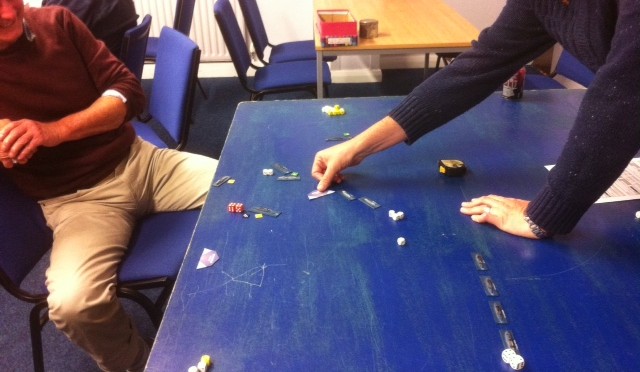
We re-fought the Battle of the Falkland Islands in the same manner as Coronel a few weeks earlier, using 1/3000th miniatures and Grand Fleet rules.
The order of battle was:
German Main Force (Von Spee: Simon Clarke)
Scharnhorst (AC), Dresden (LC), Leipzig (LC)
German Scouting Force (Captain Maerker: your humble author)
Gneisenau (AC), Nurnberg (LC)
British Battlecruisers (Sturdee: Dene Green)
Invincible (BC), Inflexible (BC)
British Armoured Cruisers (Stoddard: Andy Dumelow/Dene Green)
Kent (AC), Cornwall (AC), Carnarvon (AC)

British Scouting Force (Luce: Andy Dumelow)
Glasgow (LC), Bristol (LC)
Unattached British Ships
Canopus (BB), Macedonia (armed merchantman)
We added in a few extra rules to reflect the nuances of the battle historically:
The Invincible and Inflexible were subject to my own “British Battlecruiser” rule, i.e. when each group of hit boxes was ticked off, they could spontaneously explode on a roll of 1 on a d6;
The Canopus, of course, could not move;
Carnarvon was suffering boiler problems, and so was reduced in speed.
The Game: How It Played
We deployed the Gneisenau as it was historically, i.e. in extreme gun range of the Canopus. Merker’s squadron turned away to get out of range…this is when the battlecruisers appeared, coming full steam out of Port Stanley harbour, their flank protected by Luce’s light cruisers.

Instead of fleeing, the Germans instead turned to cross the T of their much bigger opponents. This gave Sturdee the opportunity to put a few salvoes into the hapless Nurnberg while he was pursuing the armoured cruisers, crippling it early on. Meanwhile, Sir John Luce’s light cruisers engaged in their own battle with the German equivalents, HMS Glasgow in particular gaining revenge for the British humiliation at Coronel…it outmanoeuvred and eventually sank the Dresden.
Von Spee’s manoeuvre paid off brilliantly and Scharnhorst and Gneisenau were able to put salvo after salvo into the Inflexible (although not until the latter had also done serious damage to the Gneisenau). Eventually the Inflexible was sunk, followed by Maerker’s flagship.

This coincided with the late arrival of Stoddart’s armoured cruisers, who added some muscle to the British attack. Discretion became the better part of valour and the remaining Germans fled. As with the historic outcome a British triumph, although the loss of the Inflexible made it a Pyrrhic victory.
Casualties
German: 1 AC sunk (Gneisenau), 1 LC sunk (Dresden), 1 LC crippled (Nurnberg)
British: 1 BC sunk (Inflexible), 1 BC crippled (Invincible), 1 LC badly damaged (Glasgow).