Gemauerthof 1705

In 1704 the Swedish territory of Ingria (South of Finland on the Baltic coast) fell to the Russians. They planned to take another Swedish Baltic territory, Courland, in their 1705 campaign.
The main Swedish army under Charles XII was quartered well to the south around Warsaw with only around 9000 men under Major General Lewenhaupt left to garrison the whole of Courland. The Russians organized an invasion force under Field Marshal Sheremetev with the aim of cutting Lewenhaupt off from the main Swedish base at Riga and bringing him to a decisive battle. The force comprised 9 dragoon regiments (7000 men), 3 infantry regiments (3000), irregular Cossack cavalry (300), 6 light guns and 10 howitzers.

1

Collecting as many men as he dare from various garrisons in Courland Lewenhaupt put together a force of around 7000 (approx. 4500 infantry and 2500 cavalry) . He requested reinforcements from Riga and was given an extra 1000 infantry in a combined regiment. The Swedish forces eventually gathered around the town of Gemauerthof. The Russians, encouraged by a series of successful raids and skirmishes, were eager to engage. They marched to cut off the main road to the north, putting themselves between Lewnhaupt and his escape route to Riga.
The Swedish command were also keen to engage the enemy, and decided to hold their strong defensive position against an expected Russian assault. Their left flank was secured by the wide but fordable River Schwedt and their right by the smaller but marshier course of the Klein Wilzen. Behind them was a wooded area covering the road and bridge to Gemauerthof on the opposite bank of the Schwedt. As per convention the Swedish Infantry formed the centre with cavalry deployed on both flanks.
The Russians arrived from the north-east around 5pm. They scouted the Swedish positions and decided to hold off any attack until the following morning, due to the lateness of the hour and the length of the march they had made that day. Shremetev deployed his forces for the night to cover the routes north from Gemauerthof, keeping an area of woodland between him and the Swedes. The Russians also followed convention with their infantry in the centre and a dragoon brigade on each flank, but the other dragoon brigade was sent across the River Schwedt to cover any Swedish move on that bank.

Lewenhaupt had also decided to put off any engagement until the following day, content to send out scouts with orders not to stray too close to or engage with the enemy. For some reason the Swedish Colonel Stackelberg chose to ride forward and take command of the scouting party, pushing them further forward than intended, beyond the wooded area covering the Russian army. They were attacked by the lead Russian units immediately and soon forced to retire. The Russians feared the Swedes were trying to break out or withdraw to Riga and soon the whole Russian army pursued the enemy scouts through the woods, becoming disjointed as they did so.

2

By now the Swedish battle line was advancing en masse to engage the Russians as they emerged from the woods. The fighting was fierce all along the line. The Swedish cavalry on the right hit the Russian infantry hard but they were saved when Kropotov’s Dragoons counter attacked and they managed to rally. The Swedish left wing suffered badly when they were hit in the flank by the Russian Dragoons crossing back over the River Schwedt. The Uppland regiment lost half of its strength, with their Colonel amongst the casualties, and many of the Swedish cavalry fled to Gemauerthof and beyond to spread news of defeat. The victorious Russian Dragoons failed to press their advantage, preferring instead to pillage the Swedish baggage. This gave the Swedish infantry in the centre time to react, aided by small cavalry reserves in the second line.

3

Several unco-ordinated Russian attacks were beaten off and the Swedes were then able to launch a counter attack on the Russian infantry in the centre. The Russian line was gradually wheeled back to the line of the Klein Wilzen, despite a spirited charge by Ignatiev’s Dragoons that was halted by a withering Swedish salvo. Both sides were thoroughly disorganised after more than two hours fighting and they paused to reorganize their lines. The Russians were now formed up along the eastern bank of the Klein Wilzen and the Swedish on the west bank.
Lewenhaupt planned another co-ordinated attack on the shaken Russians, but the impetuous Stackelberg again pre-empted him and led his own cavalry assault first. Confused fighting with minor breakthroughs and repulses continued until around 9:30pm. By now both sides were exhausted but still holding formation. The Russians used nightfall to make an orderly retreat, but it seems to have degenerated into a near rout. The Swedes, exhausted and still wary, did not pursue and remained in their battlefield positions overnight.
It had been a hard won and narrow victory for the Swedes but Courland was only briefly saved. The Russians could make good their losses, Lewenhaupt could not.
The forces used for the club re-fight were as follows –

SWEDES

C in C Lewenhaupt
Left Wing – Wennerstadt
2 superior horse, unarmoured, determined, impact, sword
1 average horse, unarmoured, determined, impact, sword

Centre – Stackelberg
4 superior foot, (4 musket 2 pike), salvo1 average foot, (4 musket 2 pike), salvo
4 light guns

Right Wing – Schreiterfeldt
2 superior horse, unarmoured, determined, impact, sword
1 average horse, unarmoured, determined, impact, sword

RUSSIANS

C in C Sheremetev
Left Wing – Kropotov
3 average horse, unarmoured, determined, pistol, pistol
1 average light horse, unarmoured, carbine, light lance

Centre – Chambers
3 average foot, (5 musket 1 pike)
2 medium guns
2 light guns

Right Wing – Ignatyev
3 average horse, unarmoured, determined, pistol, pistol

Across River Schwedt – Bauer
3 average horse,unarmoured, determined, pistol, pistol

Steve and Pete took command of the Russians for this engagement and the Danish Brothers (should that be the Swedish siblings?) Simon and Dene controlled the Swedes.
The action was fought lengthways along a 6’ x 4’ table with the Schwedt forming one long edge and the Klein Wilzen the other. A wooded area reached almost across the table width on the Russian side, concealing each side’s deployment and initial moves from each other. A road ran alongside the Schwedt from Gemauerthof northwards through the woods – the best route back towards Riga for the Swedes.

4

The only unit on table at the start of the battle was a base of mounted Swedish scouts. They were pushed forward towards the supposed Russian position at march speed, and again when they were joined by Stackelberg. At this point random dice rolls determined how quickly the patrol would spot the Russians and how far away they would be. The rolls went well for the Swedes with the enemy spotted at the first opportunity and as far away as possible.
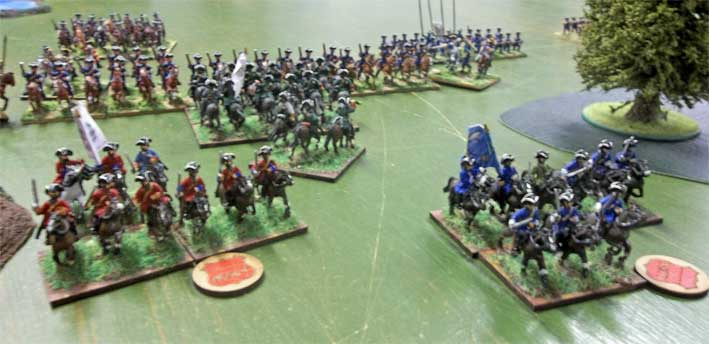
The patrol was thus able to turn and retire to their lines without panic, especially as the Russian response was tardy and halted in the gap between the edge of the woods and the Klein Wilzen. Here they could see the entire Swedish army drawn up for battle. The rest of the Russian army was informed and duly advanced to meet the enemy. The Russians were soon disordered by the woodland and rethought their battle plan. Why not pull back to their side of the woods and let the Swedes fight their way through disordered and disjointed? Kropotov’s Dragoons would delay the Swedish horse on the Russian left with the support of the Cossacks who could pick their way along the marshy banks of the Klein Wilzen. On the other wing Ignatyev’s Dragoons could cover the road exiting the woodland whilst Bauer’s Dragoons could cross the shallow Schwedt and threaten the Swedish flank.
5

The Swedes had expected the Russians to attack, but a stand-off would still give the enemy victory as they would still hold the road north to safety and supplies. The Swedes thus decided to take the battle to the Russians. Another opportune die roll revealed Bauer’s attempted flank move across the Schwedt to the Swedes. They sent just one unit in column along the road into the woods to hold the route north, whilst Wennerstadt’s other units shadowed Bauer’s moves on the opposite bank of the river.

6

On the Swedish right Schreiterfeldt’s and Kropotov’s commands clashed. The Swedes soon came out on top with their only casualty falling to a lucky carbine shot from the Cossacks. Kropotov’s Dragoons were soon in flight and reserves had to be brought across from Ignatyev’s command. On the other side of the table the Russian and Swedish cavalry had spent a couple of moves facing off across the river. With things going badly on the other wing the Russians had to make a move. They would be disordered crossing the river, be mostly outclassed, and have to survive the initial Swedish impact. But they had numbers on their side and maybe that would be decisive. It wasn’t. The first unit to engage fought well for a couple of rounds but eventually routed and lost their general. Reaction rolls from the remaining Russian Dragoons were dire and they soon followed.

7

With both wings routing and the Swedish infantry picking their way through the woods the Russians wanted to concede. We persuaded them to carry on a while. The Swedish infantry would emerge from the woods piecemeal, to be met by fresh Russian infantry and artillery. As the first unit came into the open the Russians gave it everything. The Swedes came through unscathed and took out the first Russian infantry battalion in the impact and ensuing melee. There was no way back for the Russians now and a decisive victory was awarded to the Swedes.
Almost all of the historical account is based on ‘The Russian Campaign in Courland in 1705’ by Vladimir Velikanov and Sergei Mekhnev in ‘Great Northern War Compendium’ volume 1 by THGC publishing 2015. An invaluable piece of work on what is still an underrepresented conflict in the English language and on the tabletop.
Godendag 2017

GODENDAG 2017

15MM ANCIENT/MEDIEVAL/RENAISSANCE DOUBLES COMPETITIONS

28TH & 29TH JANUARY 2017


NEW VENUE:
Firestorm Games (Cardiff) (Tel: 02920 227117)
Trade Street
Penarth Road
Cardiff
CF10 5DT
United Kingdom

Mortem et Gloriam

Any published army
The list submitted must not exceed 12000 points.
Umpire and list checker: Alasdair Harley

alasdairharley@hotmail.com

Field of Glory: Ancient/Medieval

THE MEDIEVAL WORLD

Any army from 600 AD.
The list submitted must not exceed 900 points.
Umpire and list checker: Richard Bodley Scott.

rbs@byzant.demon.co.uk
Rules: See below

Field of Glory: Renaissance

EUROPE’S TRAGEDY

Any European army 1618-1648 (including Russia and Turkey).
The following list modifications and additional restrictions will apply:

To represent usual historical proportions in European armies of this period, ignoring artillery, the army cannot include more than 1 battle foot unit more than it has battle mounted units. (e.g. If you have 5 BGs of mounted battle troops, you can have up to 6 BGs of foot battle troops).

No more than half of all mounted battle troops can be Superior or Elite. Armies with insufficient Superior mounted battle troops in their army list to achieve this limit can upgrade whichever type of Average mounted troops in their list is most expensive in points to Superior to achieve the above limit.

No more than half of all foot battle troops can be Superior or Elite.
The army must have at least 6 bases of foot battle troops per heavy or medium artillery base.

The list submitted must not exceed 900 points.
Umpire and list checker: Richard Bodley Scott. rbs@byzant.demon.co.uk
Rules: See below

DBM

Any army. List not to exceed 500 points.

Umpire and list checker: John Graham-Leigh

jandagraham-leigh@blueyonder.co.uk

L’Art de la Guerre

400 points doubles, made up of 2 x 200 point armies (each army must be no more than 210 points with a total combined army size of maximum 400 points). The armies chosen must be listed as potential allies in either army list.

Armies drawn from Ancient Period, Classical Period and Roman Period lists (1-124 inclusive)

4 Games, same games times as the other periods

Umpire and list checker: Mike Baldwin

———————————————————————-

Cost: £ 25.00 per team of 2.

(Food will be available on site, but is not included in the entry price).
Tickets are available from Firestorm’s web site: http://www.firestormgames.co.uk/events

CONTACT: RICHARD BODLEY SCOTT, 28 PRIORY GARDENS, USK, MONMOUTHSHIRE, NP5 1AJ (RBS@BYZANT.DEMON.CO.UK)

———————————————————————–

GODENDAG 2017
VENUE:
Firestorm Games (Cardiff)
Trade Street
Penarth Road
Cardiff
CF10 5DT
United Kingdom
Tel: +44 (0) 2920 227117


TIME: 8.30 – 9.00 – Registration time on Saturday

Games will be:

Saturday: 9.30 – 1.00 and 2.00 – 5.30
Sunday: 9.00 – 12.30 and 1.30 – 5.00

ENTRANCE: £ 25.00 per team of 2. (Food will be available on site, but is not included in the entry price). Tickets are available from Firestorm’s web site:

LOCAL ATTRACTIONS:

If you are able to make a long weekend of it, there are numerous local historical attractions relevant to our period. These include the Roman Legionary Fortress and Museum at Caerleon and the Roman walled city of Caerwent. Among the many local castles, the best are Chepstow, Raglan, White Castle (at Llantilio Croesenny) and Caerphilly. Caerphilly castle has a permanent exhibition of full size working medieval siege engines including ballista, mangonel, trebuchet and perrier. The Welsh Folk Museum at St. Fagans is worth a visit. The Brecon Beacons National Park and the picturesque Wye Valley are also nearby.

QUERIES: Richard Bodley Scott, 28, Priory Gardens, Usk, Gwent, NP5 1AJ. (rbs@byzant.demon.co.uk)

————————–

FOGAM/FOGR TOURNAMENT RULES

1) Godendag is a Doubles competition. Each army is to be commanded by 2 players. Consideration will be given, however, to entries with only one player or three players if there are special circumstances.
2) The rules to be used are the current Field of Glory rules, together with the latest errata and FAQ posted on the official Field of Glory web site.
3) The competition will use the full rules including the terrain and set-up appendices. There will be no formal division of the battle groups comprising each army between the members of a team. It is usual, however, for each player to take control of the troops on about half of the battlefield.
4) The scoring system will be the standard FOG tournament scoring system, where 25 points are up for grabs each game.

5) Army lists must specify the number and size of battle groups and their order of march for deployment, and the number and type of commanders chosen. They should also include the total pre-battle initiative modifier and the territories list for the army. If the detached shot option is to be used, a second list differing only in this regard must be submitted. Once an army list has been submitted it may not be changed or altered other than to correct any errors. Players may only correct their errors by making reasonable changes to their list. It is not allowed to completely re-write the list, and the list checkers decision on this is final.
6) Please note that the Godendag 2017 Field of Glory event is a single list format. Any incorrect list discovered after a game has commenced (after set up dice have been rolled) must be corrected prior to deployment if spotted in time, and fully corrected in any case before the next match.
7) Army lists must be submitted for checking in advance and must be received by the Tournament Organiser by 14th JANUARY 2017.
8) The Tournament Organiser and List Checker is Richard Bodley Scott (rbs@byzant.demon.co.uk) 28 Priory Gardens, Usk, Monmouthshire, NP5 1AJ.
9) Players must fully define their troops as they are placed on table. Figures must provide a reasonably accurate representation of the troops they are trying to represent – they must not look deliberately misleading.
10) Table size is 6′ x 4′ and players must supply their own terrain pieces. These must be to an acceptable standard, and umpires will have the discretion to remove unsightly items. In addition all figures must be representative and painted and based to an acceptable standard.
11) Players must be present and ready to start the match at the appointed time. Where a player has a reasonable excuse for arriving late the match start will be delayed by up to 30 minutes. After which time the affected player will be awarded a bye. No player will be awarded more than one bye for any reason.
12) If a player resigns from a game at any stage after the first set up dice have been rolled their opponents will be awarded maximum points, and they will be awarded 0 points.
13) Time will be called after 3 hours 20 minutes plus up to 10 minutes. Play will stop at the end of the current phase. Players may always commence games earlier than the stated time by mutual consent, in which case their game continues until time is officially called as normal.
14) Admission to the tournament is at the sole discretion of the organisers and their decision on all matters is final. CONTACT: Richard Bodley Scott, 28 Priory Gardens, Usk, Monmouthshire, NP5 1AJ

Squarebashing 1914 – Russians vs Germans

Last night was the debut for the Russians. As part of a horse trade deal a long time ago I didn’t have many options of composition. The 620pt force being

  • 3 regular
  • 10 reservists
  • 1 professional cavalry
  • 2 regular cavalry, 
  • 2 reservist cavalry
  • 4 MG
  • 4 Artillery

So a veritable horde… with more cavalry than I’m used to.

img_3231

 The game was against Rays 1914s Germans, and his army was larger than normal with 3 units of his own cavalry and , no professionals at all. 

With our usual lackadaisical start neither of use invested much effort in the countdown to war, just using the normal default values. Through slightly better dice the Russians won and ended up attacking – reconnaissance in force.  Things to note

  • Ray rolled low twice on the events chart and ended up deducting 6 from his artillery assets
  • On the events I scored the opponent cannot deploy in the 2 end columns (on one side) & one turn of no scenery penalty movement. 

So, the game. As attacker I tried to move all the terrain to my side of the table and hopefully time it well with the movement event. This worked  reasonably successful.  The master stroke was that having 5 units of cavalry allowed me to utilise the vacant columns in the first turn – this was a real game winner. Moving first meant big columns of Cossacks racing down the flanks with relative impunity.

 img_3232

The mob of Russian  infantry lurched out of all the bad going, and was looking frighteningly powerful as after the depletions of the German left flank left them looking fragile.  A well placed point effect on the German positions meant that they would have a rather painful morale phase.  It might all be over for Christmas!

However, the cruel mistress that SB is had other plans. The German turn saw a suppression barrage placed skilfully over the whole Russians advance. With 13 units of infantry it hard to disperse them to reduce effect. While the suppression barrage is not ‘a killer’ in as much as the casualties it inflicts are smaller. The Reservist saves usually mean that there is a casualty and therefore cause for a moral test. This is really exasperated by the factors of reservists, under barrage with casualties… the morale dice just rack up.  The Russian duly failed most of the tests  – AND  – then because they are suppressed cannot retire and take another 6 hits … again with terrible reservists saving throw.  It started brilliantly and turned to **** in one turn. It looked like the entire infantry assault had stalled due to one suppression barrage!

 img_3233

The Cossacks were have more freedom running around the German rear. They had already destroyed one unit of German cavalry and were looking for  targets of opportunity.

The Germans were holding on and took some rather risky strategy with their reserves which did not pay off, they ended up with their artillery exposed in the line allowing the stoic Russians to press in those two places. However , the dice dictated against it ,even with a couple of guns they beat of a sizeable Russian infantry assault. The guns had good support and the dice were wacky.  So rather than breaking the German lines in two places, the Russians stalled and ended up standing right in front of the German lines.

The Russian cavalry in the rear delivered a textbook flank charge on the German reserves after a textbook point effect barrage preceded it  – damaging the MG – UUUrah! The Germans scattered off table , losing bases left, right and centre. Moving off table was probably best thing for them as while taking a savage beating they were still ‘at strength’ and now safely in reserve so victory points that could be gained would be limited.

 img_3235

As the game concluded the game looked favourable to the Russians, and fate had seen big swings in fortune in this game. The Russians has achieved 2 breakthroughs , captured 2 out of 4 objectives and occupied the max allowed squares in rows 2 & 3.  However, this was countered but a frightful 27 bases of ‘killed’ troops and Ray having some re-roll events on the objective scored. SO, it ended up with a +7 to the Russians – Minor Victory. The Russians, while on paper look poor and their army rating of 27 reflecting that, have some good synergies. The cavalry and empty flank zones is a great combination. The sheer mass of reservists gives them great resilience … but not for the feint hearted as you cannot make an omelette without breaking some of those Russian eggs.

Great game. Squarebashing always delivers a fun evening with lots of twists and turns.

Squarebashing Day – 10th Dec – Battlefield Hobbies.

squarebashing

With a drum roll….! The date for this is Sat 10th December 2016.

The venue is now Battlefield Hobbies in Daventry.

Hopefully the centrally located venue will help those on the periphery of the country. The entry fee is £10 per player. This includes lunch 🙂

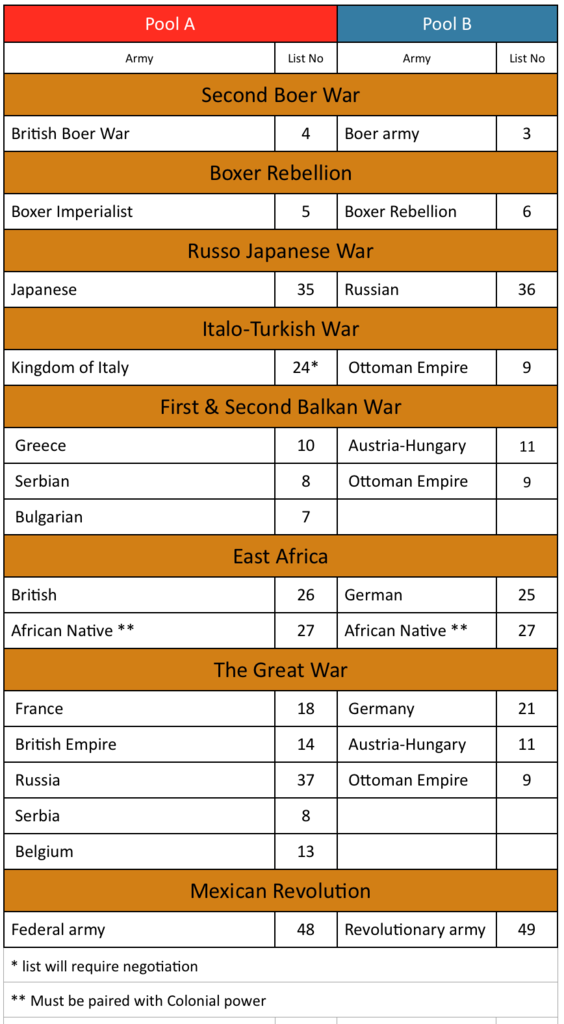
The theme will be “up til the guns of August”. The period will from 1900 up to, and including 1914. It will be a team event (entries permitting). The armies are divided into 2 Pools, grouped by conflict. Each team must pick a pair of armies from a single conflict.

The allowed lists are –

There will be 2 games, Team against Team (As vs Bs). For each game he sum of each team score will be added to the team total. To encourage using under valued armies the sum total of army rating will be deducted from final score.

The terrain will be pre set , other than its RAW. All painted figures please, we want it to look nice!

If you want the full experience there is a t-shirt accompany the event. Profits from which help to finance the RFCM forums (£2)

RFCM shop

screen-shot-2016-09-11-at-19-54-26

Thanks Simon

Age of Sigmar – this time High Elf Alliance

Today we played round two our Age of Sigmar competition. As we found out we were 1 week later for the summer campaign , so the results would just be for our own fun. Today I gave a run out for my High Elves.

I took Althran Stormrider Host war scroll battalion . Which consisted of

  • Hero on Griffon
  • Elf Mage
  • 5 Swordmasters
  • 10 Lothern Sea Guard
  • 5 Ellyrian Reavers
Actually the contents of the Battle for Blood Island- which I have – and 600pts exactly. Looking like karma…
Logans Seraphon remained the same
  • Skink Starpriest
  • 20 Saurus warriors
  • 10 Skinks with javelin
  • 10 Skinks with blowpipe
  • 3 Ripperdactyls
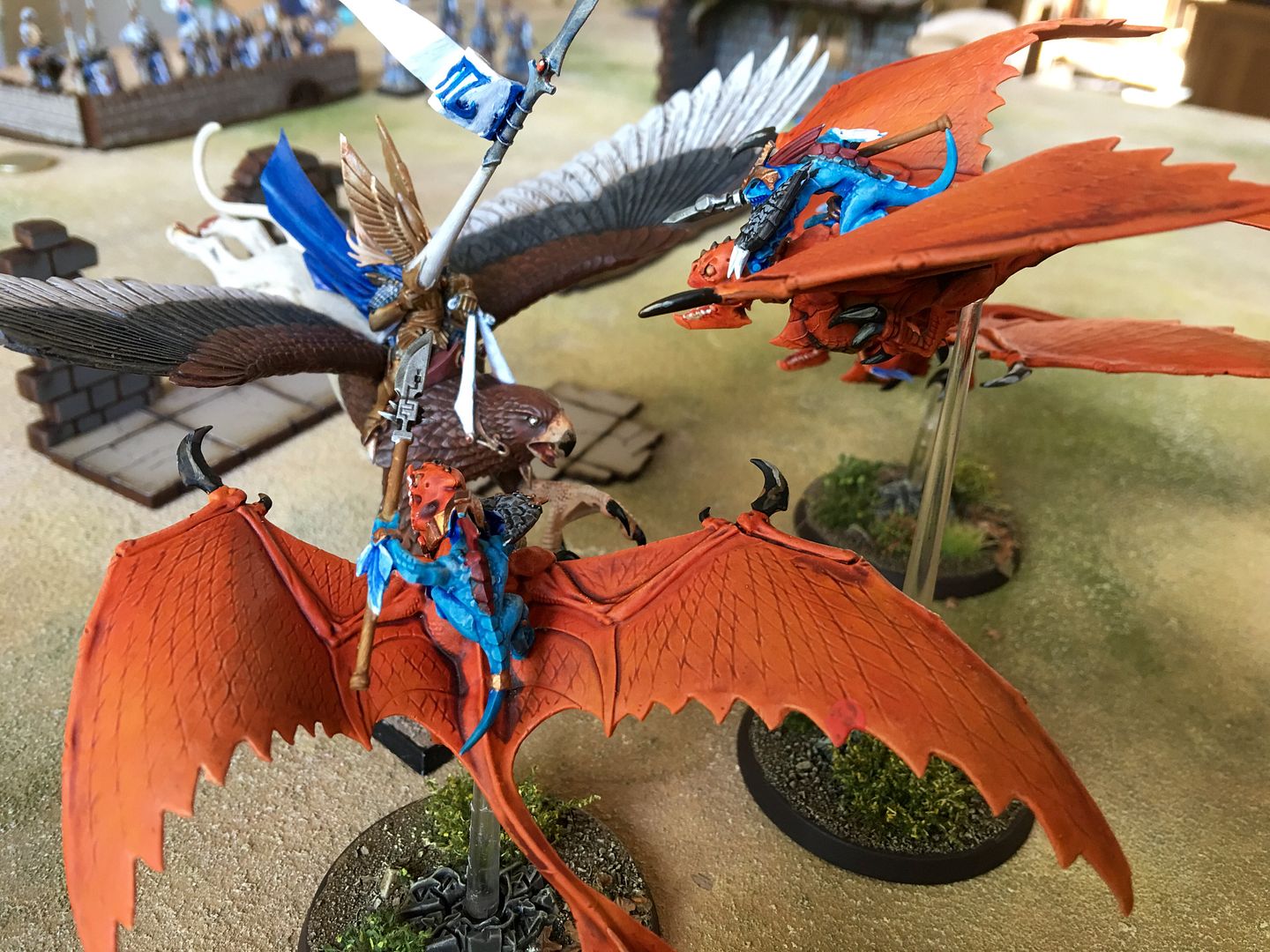
The elves looked very outgunned. After reading the warscrolls then it seemed like the older models didn’t have such an oomph as the later releases. We played take and hold again, with slightly less terrain (doing away with the nonsense polystyrene tiles!). The game has a string narrative. Serpahon starting   – with Ripperdactyls off table, ready for their swooping attack. There was a general advance The Saurus drummers allowing them to march – but then not to charge. In the subsequent Elf turn Althran on his Griffon showed was a monster can do. With Hand of Glory cast (re-roll hits and wounds) with a massive 16” one – he is flying – then rolling a double 6 for the charge allowed him to charge whoever he wished. The target was the big block of 20 Saurus warriors.
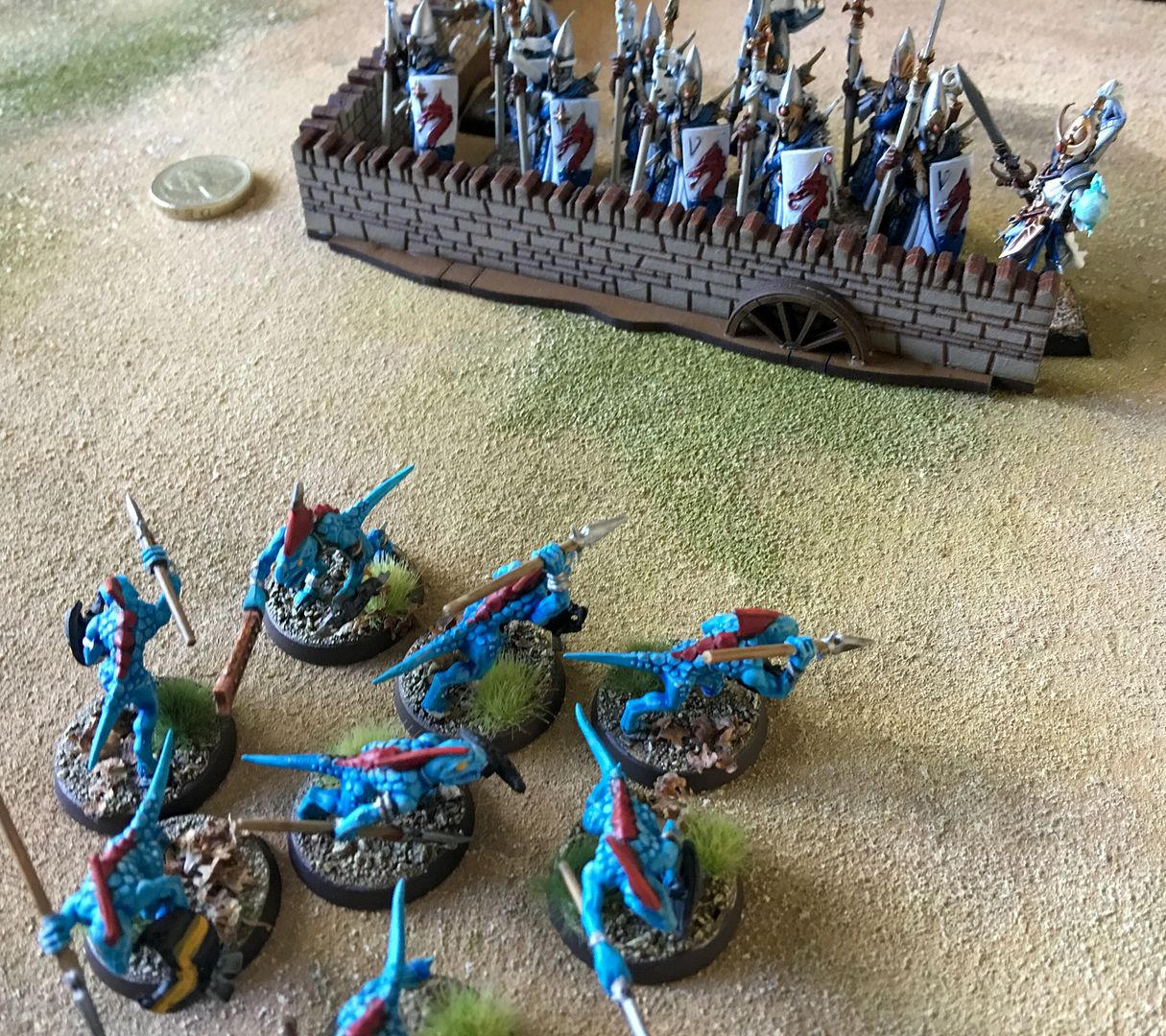
He did great dispatch, inflicting 10 casualties on the unit.  The Saurus had already taken 2 casualties from an Arcane bolt earlier in the turn. in the Battleshock phase Logan threw a 6 , adding 12 … even with a bravery of 10 that meant another 8  lizardmen fled the field. The mistake was not to have given them inspiring presence that turn ( given to some Skinks who were skirmishing ahead of the lines). So it was looking good for the Elves from the get-go. However, in the next turn the Ripperdactyls cinematically swooped down to wreak revenge! this they did.
With their initial boosted attacks from the warscroll battalion they took Althran down to 2 wounds with their clawing attacks to start. The beak attacks are only 1 dice attack, but each time they are successful they get to roll another attack. These exploded attacked finished off the brave elf nobleman. The following turns saw the elves turing their attention to the Ripperdactyls and pepper with arrows and a few arcane bolts saw them off. With all the big beasts gone, it was down the infantry. The Ellyrian reavers had also been picked off by the Rilpperdactyls. The sword masters had some success , but with only a low model count they suffer from mortal wound spells (arcane bolt ect), as soon as they are less than 5 their usefulness to capture objectives is diminished. Finally the skinks ran out of room. As ‘wary fighters’ they can break off from combat , being safe to shoot next turn. However against the elves who shoot back …and with elf shields 4+ save (re-rolling 1s & 2s in shooting) they were getting the worse of the deal.
The final nail came with a the Elf mage longbombing a charge to attack the Skink Starpriest. With ‘Arcane bolt’ followed up with ‘hand of gloried’  sword and the tiny lizard was dispatched.
 
So victory for the elves, only minor as they didn’t have enough troops to hold both objectives!
Great game. I’m really enjoying these Age of Sigmar games. They have a real simplicity, but with some clever decision making. No monsters are too powerful as they can be ground down by infantry. Infantry are vulnerable to high losses due to battleshock, so nothing is massively survivable. Its hard to make anything approximating a deathstar! no 2++ re-rollables here