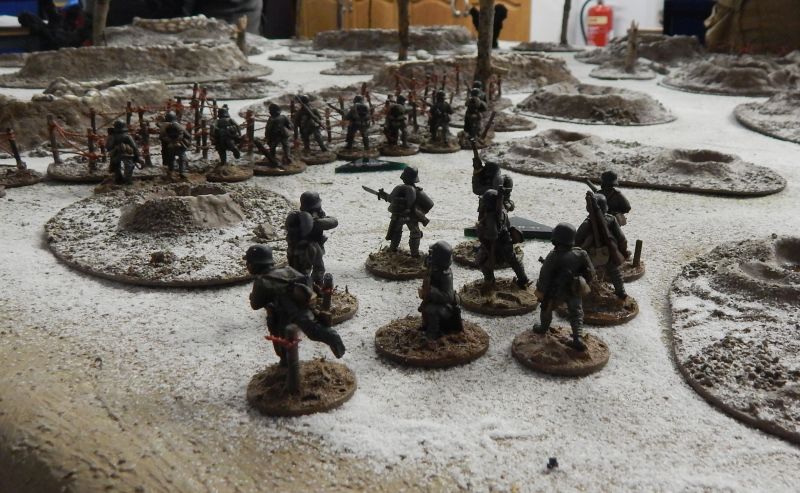
By way of a change we played ‘The Great War’, the Battlefront WW1 FOW version of the rules. Cousin Mark came over and brought his toys to give them a run out. The Great War (GW) is just a simple derivative of FOW. The scenario we played was 1918 trench battle – The Big Push. The two armies were Germans consisting of 2 rifle platoons of infantry with attached MG and anti tank rifles, an HMG platoon and finally 2 A7Vs (5 platoons strength). They were all classed as confident trained. The British consisted of 2 rifle platoon, with MGs attached, and 3 Male tanks. All of whom were rated veteran. The Germans obviously have picked the wrong bit of the trench to attack!
In order to re-fight Coronel, it was crucial that the ship’s stats for the various ships was, relatively speaking, as accurate as possible.
The word documents below cover both squadrons, von Spee’s and Cradock’s. Cradock’s squadron includes the “What if…?” variant, specifically the addition of the Canopus and Defence. Note that the Canopus has a special rule concerning its movement; this stimulates the rather dodgy boilers which plagues the ship at this period, and led to her being beached in Port Stanley as a fortified bunker.
The other thing that needs considering is the quality of both admirals. Although the Royal Navy already has a number of disadvantages, their relative qualities means that von Spee is rates +2 on the initiative dice, and poor old Cradock -1.
For the “What if…?” variant, you can argue that Cradock was not a bad admiral, he simply had poor ships. In which case you can rate von Spee at +1 and Cradock at 0.
As part of the ongoing commemoration of the Great War, my contribution was to go down a different route from the excellent Squarebashing games; my chosen interest was the naval aspect of the war.
There are many rules and figures out there. The rules I ended up going with are the “Grand Fleets” rules, published by Majestic 12 Games. They have the advantage of a tow-tier approach…an entry-level set of rules to get players warmed up and used to them; and a complete set, which are far more detailed and enable the subtleties of the period to be captured. In addition, the entry-level rules can be downloaded for free.
In terms of scales, well, the two most common are 1/1200 and 1/3000. In the end I plumped for the latter. The ships may be a bit small for the initial cruiser battles I had planned, but I did have half an eye on something much larger…Jutland, with its 100th anniversary in May 2016.
But I needed something more modest to get the BAD Wargamers interested and familiar with the rules. The Battle of Heligoland Bight was the first significant naval action of the war, but it’s quite a complex affair, so I plumped for something manageable, namely the Battle of Coronel.
Background
The German East Asia Squadron was one of the Imperial Navy’s elite units: the most modern cruisers, the best crews, and commanded by one of the German navy’s most promising officers, Vice-Admiral Graf Maximilian von Spee. It was based in the German enclave of Tsingtao in China.
In anticipation of the start of the war, von Spee moved the squadron to the German Caroline islands. On the outbreak of war, he dispatched the light cruiser Emden to the Indian Ocean to create mischief (another story) and proceeded to raid allied bases and attack merchantmen in the Pacific with the rest of the squadron. Even without the Emden, he still had a powerful raiding force: the armoured cruisers Scharnhorst and Gneisenau; and the light cruisers Leipzig, Dresden and Nurnberg.
SMS Scharnhorst, von Spee’s flagship
When Tsingtao was invested by the Japanese, von Spee decided to make a dash for home via Cape Horn, causing as much mayhem as possible on his way back to Wilhelmshaven.
When the Royal Navy realised he was off the Pacific coast of South America, they dispatched the only force they had in the area: a small cruiser force at the Falkland Islands commanded by Rear Admiral Christopher Cradock. Cradock’s force could not have been more different from von Spee’s; he had two obsolete armoured cruisers, the Monmouth and his flagship the Good Hope; the pre-dreadnought Canopus; an armed liner Otranto; and his only modern ship the light cruiser Glasgow. He was due to be reinforced by the modern armoured cruiser Defence, but halfway down the Atlantic the latter was redeployed to chase the German battlecruiser Goeben in the Mediterranean.
HMS Glasgow
On receiving his orders, Cradock left the Canopus behind (due to ongoing boiler problems) and went up the coast of Chile to find von Spee. He did so on the 1st November 1914, off Coronel. Von Spee skilfully avoided battle until the sun had sunk behind Cradock’s force, silhouetting them against the horizon. Scharnhorst and Gneisenau put salvo after salvo into the British armoured cruisers until they went down (without even landing a hit on their German counterparts). The Glasgow, which had the honour of being the only Royal Navy ship to land a hit on the Germans, made use of its speed and escaped. The Otranto, wisely, fled south as soon as von Spee’s squadron was observed.
The Battle of Coronel
It was a bitter blow for the British, the first defeat for the Royal Navy since the days of sail, and the anger and dismay were felt throughout the Empire…
The Refights #1 and #2
As part of the first go at the Grand Fleet rules, we did a straight refight of the Battle of Coronel. Simon Clarke took the role of von Spee and Andy Dumelow as Cradock.
As expected, the battle went according to history, with a resounding German success. This time the Otranto and Glasgow also got seriously stuck in and went gallantly to a watery grave. A few more hits landed on von Spee’s squadron than was the historic outcome, but nothing to trouble the German navy too much.
As we were using the entry-level rules, and the game was quite a small one, it was over in an hour. That gave us the opportunity to try out a “what if” variation. This time we gave the Brits both the Canopus and the Defence. The outcome of the game was a closer one, with the Nurnberg getting sunk and several other German ships getting damaged but once again the victory was von Spee’s.
Next time we shall re-fight the Battle of the Falkland Islands…British Revenge?