Martin Stevenson – Best Presented Army.

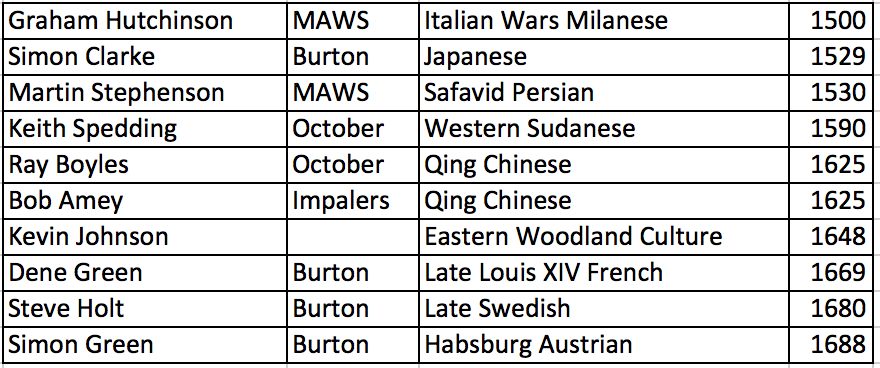
Simon Green “Oh No, Dene’s going to get more points than me!”

Steve Holt – with Keith Spedding looking-on in shock & admiration that someone could do so well with average Swedes!

The Periods
Last Trumpet of the Elephants, Southern Asia 1650-1698
Minimum of 4 Elephant bases, no more than 16 bases of Superior Battle Troops
Peasant Revolts and their Overlords.
An army must have as many poor bases as it has sup/elite bases. (mob and LF count towards these totals)
Friends and Enemies of Charles II and his wife 1660-1685.
Artillery rules for all periods
1) Must have 6 bases of foot battle troops for each base of Lt/Med/Hvy artillery
2) All heavy artillery starting the battle unlimbered must be deployed first. Limbered heavy artillery may be deployed at any time. The army list must specify whether the artillery is limbered or unlimbered. The player may send in two army lists with different order of marches only, depending on whether they want their heavy artillery to start limbered/unlimbered or a combination of both if they have more than one BG of Heavy artillery.
3) Light and medium artillery can deploy at any time during the order of march.
4) If artillery is captured, the player who has captured them can at the end of the turn in which he has captured them, during the JAP phase, after all auto routing troops have been removed, choose to remove the artillery.
Allies and special options are allowed if specified.
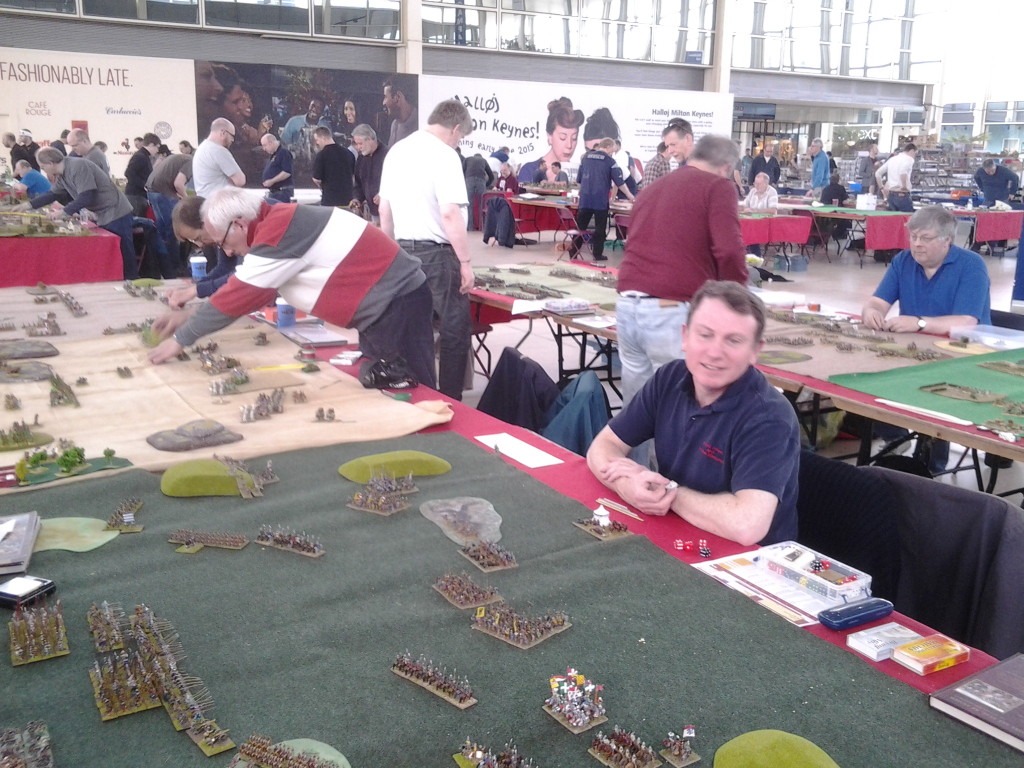
BAD players at MK
Plenty of smiling faces from the Burton team and BAD mercenaries!
He are the final results (with a pat on the back to Dene & Wayne)
1st Forlorn Hope 240
2nd Central London Mediocre 188
3rd October 164 (tie breaker result between the two teams)
4th Les Trois Mousquetaires 164
5th Burton and District 124
6th Wooden Spoon 100
Last Trumpet of the Elephants
1st Bob Medcraft, Forlorn Hope, Indonesian, Johor Sultanate w Dutch Allies, 1693 70
2nd Wayne Charleton, Burton and District, Rajput Hindu Indian 1650 64
3rd Chris Beesley, Les Trois Mousquetaires, Indonesian, Johor Sultanate w Dutch Allies, 1695 60
4th Tim Porter, Central London Mediocre, Vietnamese 59
5th Ray Boyles, October, Indonesian, Johor Sultanate w Dutch Allies, 1650 58
6th Will Denham, Wooden Spoon, Hindu Sinhalese w Dutch Allies, 1650 9
Peasants and their Oppressors
1st Dave Parish, Forlorn Hope, German States (South or East) 1524 71
2nd Dene Green, Les Trois Mousquetaires, German States (South or East) 1524 52
3rd Dave Allen, Central London Mediocre, Hungarian Peasants Revolt 1525 49
4th= Stephen Stead, October, Slovenian Peasant Revolt 1516 48 (No tie breaker their game scored 10/10)
4th= Lynette Maxim, Burton and District, Hungarian 1514 48
6th Nigel Emsen, Wooden Spoon, German Peasant Revolt 1525 32
Charles II Friends and Foes
1st Ben Jones, Forlorn Hope, Later Dutch 1680 99
2nd Simon LeRay-Meyer, Central London Mediocre, Later Dutch 1680 80
3rd Paul Kitcher, Wooden Spoon, Later Dutch with Later Spanish Allies 1673 59
4th Keith Spedding, October, North African States 1680 58
5th Martin Val Tol/Tom Elsworth, Les Trois Mousquetaires, Restoration British in Tangiers 47
6th Steve Holt, Burton and District, Later Spanish 12
Ferdinand Kettler peered out from his observation post on a misty summer morning across the stretch of water under his command. All seemed clear, as it had the day before and all the days he had been stationed there. He knew the enemy would be mad to attempt to land here and had assured his generals “even a superior force of three hundred thousand would still not be enough to successfully achieve any progress”. Then the mist began to clear and dark shapes could be seen on the water. They were small boats, scores of them,
approaching the shore and they were accompanied by a covering artillery barrage. As Kettler gathered his thoughts and his command the first wave of enemy troops came ashore…
Normandy in June 1944? No, Livonia (modern day Lithuania) in July 1701. The Great Northern War had begun the previous year when an alliance of Russia, Denmark-Norway and Saxony-Poland Lithuania declared war on the newly crowned King of Sweden, the 18 year old Charles XII. Despite his inexperience Charles acted quickly. Denmark was forced out of the war almost immediately,
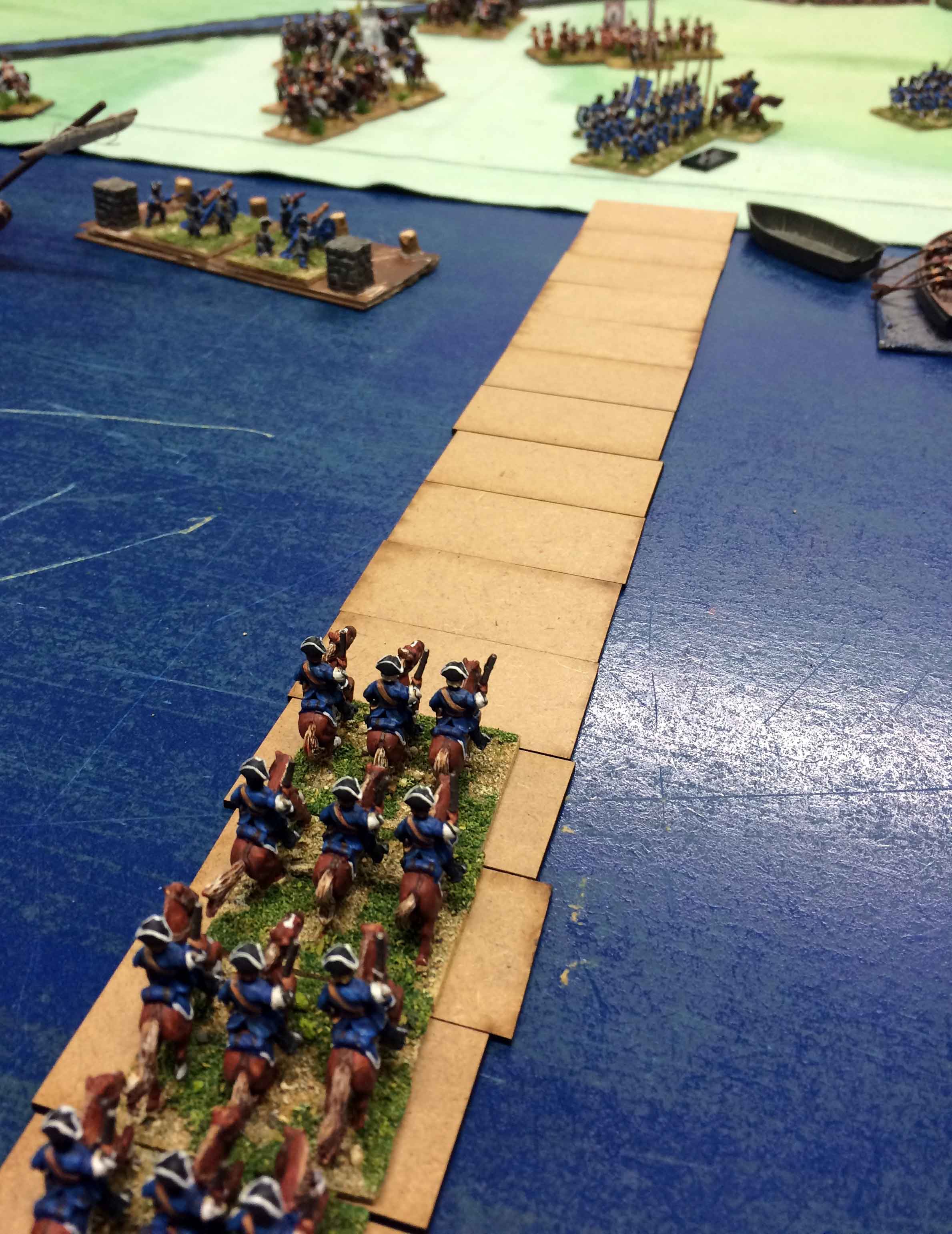
and Russia was given a bloody nose at Narva. Charles’s attention now turned to the Saxons. A combined Saxon-Russian army of c.29000 under Steinau had entrenched themselves along the west bank of the river Duna (Latvian Daugava), opposite the Swedish held city of Riga. Not knowing when or where the Swedes might attempt to cross the 600m wide river they were inevitably stretched, but put out regular patrols. Steinau was away on one such patrol with a strong force to cover a feint by Swedish cavalry, leaving the rest of his army under the command of Paykull and Kettler. The Saxon defences were set back some distance from the river bank. This reduced the chances of them being outflanked and rolled up by a Swedish landing further along the river, and reduced the threat from the Swedish artillery in Riga. It may also have been a deliberate ploy to tempt the Swedes into a risky landing on the Saxon side. The Swedes had meanwhile gathered c.200 small boats to ferry their advance guard across the river and constructed a floating bridge for their cavalry and light guns to do likewise. They also built four floating batteries and brought up a corvette to provide artillery support.
Heavy guns from Riga also contributed to their firepower and these were able to reach some of the Saxon defences. Bad weather delayed the initial Swedish attack (shades of June 1944 again!) but by 4.00am on the morning of 19th July the first wave were embarked on their little boats ready to go. More boats filled with brushwood were set alight and pushed out into the river to create a smokescreen to mask the Swedish landings. The Swedish boats were eventually spotted, but the Saxon artillery and scouting parties were unable to prevent the first wave of around 3000 troops landing. A more organised attack by around 3500 Saxon infantry was beaten off by the stubborn Swedes (as suspected led by Charles in person), who pushed on to take a Saxon redoubt and gain enough ground to complete the construction of their floating bridge. A second Saxon attack was similarly beaten off, and the Swedes were able to bring their reinforcements across the Duna. By now Steinau had returned with his reinforcements and immediately took command. The Swedes had formed a reasonable defensive line with their left flank secured by the river, but their right flank was still vulnerable. Steinau launched a third attack on this flank with his cavalry. It had some early success but was eventually beaten off. It was now around 7.00am and Steinau called a meeting with his commanders. Despite more reinforcements under the Russian general Repnin arriving, and outnumbering the Swedes nearly 3:1, he decided to retire under cover of a feint attack. The battle had cost the Allies around 1300 dead and wounded, with another 700 men and 36 guns captured. Swedish casualties were probably around 500.
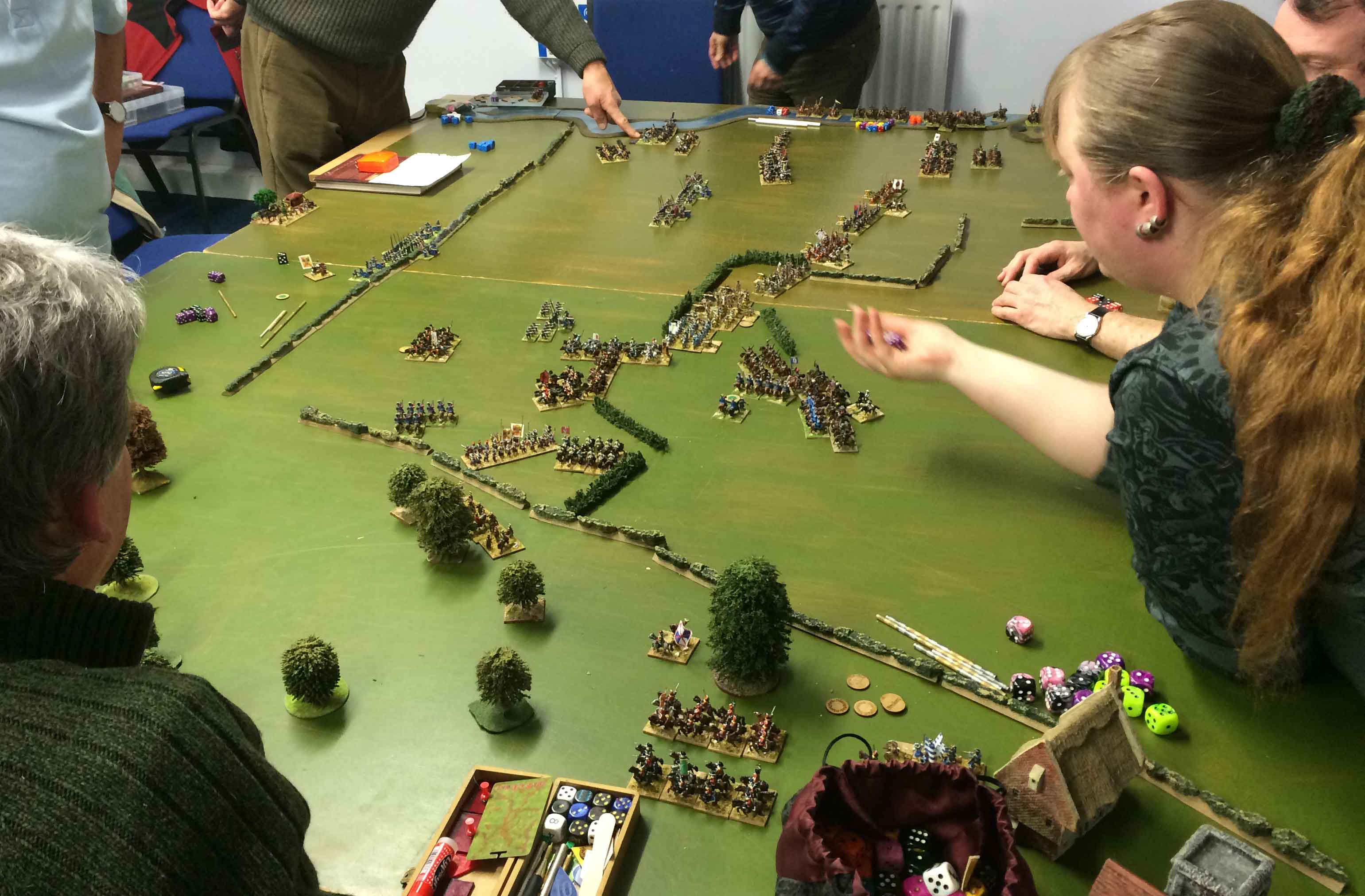
As I wanted to present a reasonably balanced club game that either side could win I won’t describe this “Crossing of the Duna” as a re-fight but rather ‘based upon’ or ‘inspired by’ the historical events. I have seen several differing orders of battle for this encounter and varying accounts of who arrived when, where and how. The forces used in this scenario were therefore something of a compromise and there was lots of dicing for arrival times and locations. The Saxon/Russian forces were commanded by the ‘Danish Brothers’ Dene and Simon Green; the Swedes were under the guidance of Paul Freeman, Simon Clarke and Steve Holt. As usual with these games both sides were in turn given a quick secret briefing on the lead up to, possible events during, and command objectives in the battle. The Swedes were given the opening move and the smoke lifted to reveal a corvette and a gun platform anchored in the river, covering the disembarking first wave of 4 Swedish infantry regiments under the personal command of Charles XII. I had allowed the Swedes to anchor the gun platform close to their landing zone on the Saxon side of the river which I thought may have been too generous – but events were to prove otherwise.
The Saxons had five infantry regiments strung out along their defence line and a redoubt with a 2-gun battery. They didn’t rush to counter the landing, fearing it could be a feint and that the main Swedish attack would come elsewhere and outflank them. They also knew they had reinforcements on the way and that their artillery had a good target in the exposed Swedish infantry. The Swedes, in contrast, went straight onto the offensive. They headed straight for the Saxon entrenchments and redoubt, hoping their second wave of infantry would secure the landing zone and cover the construction of the bridge.
The Swedish regiment on the left wing was destroyed as it reached the enemy entrenchment, but the others made it. Classed as superior, led by an inspirational commander, and with salvo capability in impact they stormed the Saxon defences. Amazingly the Saxon defenders survived this impact, but succumbed in the following round. Worse, their general was killed and the other Saxon unit defending this section was demoralised and fled, leaving the artillery to be overrun by the Swedes. The first Saxon reinforcements now arrived (three cavalry and two dragoon regiments) and on the first die roll possible!
However they entered on the table edge furthest from the action, and had to cross the front of the guns in Riga. They were hit several times during their advance, but passed every casualty and cohesion roll. As they approached a small stream between them and the enemy a second wave of 4 Swedish infantry disembarked (again on the first roll possible). Both Swedish infantry waves had time to wheel and present a more or less solid line to the Saxon cavalry and dragoons. To make a difficult situation even stickier the Swedish guns on the corvette and platform were now hitting their targets. Not everything went Sweden’s way. One of the Saxon dragoon regiments lined the river bank and found the Swedish gun platform in musket range; a series of lucky hits and unlucky cohesion rolls forced the crew to abandon their guns and dive overboard to safety. The rest of the Saxon infantry decided there were no Swedish flanking forces; they left their redoubts and marched towards the Swedish infantry. The completion of the Swedish floating bridge, and therefore their cavalry and light guns, was delayed, but the next round of Allied reinforcements arrived immediately. Yet again these reinforcements arrived on the table edge furthest from the main fight and in front of Riga’s guns, and these reinforcements were 5 regiments of poor quality Russian infantry. The Saxon cavalry and infantry now made a general advance, mainly against the second wave of Swedish infantry. These were only classed as average and the Saxons made some headway.
With a series of disastrous cohesion rolls three Swedish regiments were destroyed, and the Saxon Guard Infantry and Cavalry were able to put themselves between the Swedish floating bridge and their infantry.
When the Swedish cavalry eventually crossed the completed bridge they were met by the Saxon guard cavalry and fought to a standstill, delaying the rest of the Swedish column from landing. During all of this the Russian infantry opposite Riga had been marching to the sound of battle. As before the Swedish guns hit their targets regularly and the Russians saved their casualties regularly, but failed every cohesion test going. Two of their five regiments routed before the remainder reached a safe distance, but these were not of sufficient quality or quantity to spearhead another attack on the Swedes. The remaining Swedish infantry, with artillery support, fought back and destroyed a Saxon cavalry regiment and their Guard Infantry. This left the Saxon Guard Cavalry isolated at the Swedish bridgehead by the end of the night’s play. It was an untenable position so I gave a marginal victory tothe Swedes.
They had secured a bridgehead, destroyed the Saxon redoubt and captured their artillery, but the casualties suffered were far higher than in the historical encounter. With yet more Saxon and Russian reinforcements on the way maybe Steinau would consider another attack on the Swedish position after all…
Over the last year or so BAD Wargamers have fought out a selection of battle scenarios involving Swedish and Danish forces and their allies in the latter half of the 17th century. I must confess this was down to my wish to use my new Swedish army more often under FOG Renaissance rules, and also my preference for historical scenarios over competition style games for a club night. Such games test not just the players’ rules skill and knowledge, but also their
ability to adapt to the political, strategic and tactical limitations of their historical counterparts. They are presented with a battleground, deployment and army composition not of their choosing, and given victory conditions beyond a mere points score.
Before I describe the re-fight I’ll give a brief historical context. After the Thirty Years War Sweden was the dominant military power in northern Europe. Denmark had lost her possessions in southern Sweden and the Polish Commonwealth was in a political and military turmoil the Poles called ‘The Deluge’. In 1655 Sweden took advantage and invaded Poland. Initial success was followed by stalemate, with changing alliances and many Swedish troops bogged down in garrisons and sieges. Denmark sought to take advantage of Swedish difficulties and declared war on her in 1657. But the Swedes seized the initiative and marched an army across the frozen Baltic to overwhelm the Danes who soon agreed to a humiliating peace. Less than a year later the Swedes attacked again, but the Danes held out and with the assistance of the Dutch navy forced the Swedes to retire from the Danish mainland.
Denmark now went on the offensive. She persuaded her allies to launch an expedition onto the Danish island of Funen which still had a large Swedish garrison. The Dutch navy would blockade the island to prevent Swedish reinforcements, and two Allied forces would land and unite to destroy the Swedish garrison. The Swedes were all cavalry and outnumbered 2:1, but the Allies also had their problems. Their forces were a mix of Danish, Dutch, Brandenburg, Imperial and Polish troops, split into two commands – and the commanders hated each other! Eberstein, who commanded the Imperial and Brandenburg cavalry with a couple of units each of Dutch and Danish infantry, wanted to bring the Swedes to battle as soon as possible; Schack, in command of the Danish cavalry and the bulk of the Dutch infantry, favoured a more cautious blockade of the Swedes until they were forced to surrender. Unable to decide on tactics the Allied generals at least agreed to take command on alternate days, and on the morning of their arrival before Nyborg Eberstein was in overall command.
They found the Swedes drawn up in a strong defensive position. Their entire front was covered by hedges, their left flank secured by the sea and their right by woodland. Six units of veteran cuirassiers formed each flank command, with the right also having a unit of dragoons in the edge of the woods . A few artillery pieces were placed in the centre, with 4 infantry regiments that the
Swedes had managed to run through the Dutch naval blockade.
The Allies drew up in two lines – Eberstein in front and Schack to the rear. Eberstein’s formation largely mirrored that of the Swedes, with two strong cavalry wings (the left reinforced with a Dutch infantry regiment) and a centre of 3 Danish/Dutch infantry with artillery behind hedges. Schack had two smaller cavalry wings and the bulk of the Dutch infantry. Eberstein still doubted Schack’s commitment to battle, and launched his assault before the second Allied line was in position. The Swedish cavalry counter attacked on both flanks and the battle raged for over two hours with the Swedes gradually gaining the upper hand. In the meantime Schack had brought the Allies second line right wing cavalry and Dutch infantry up. With the extra numbers and fresh troops the tide turned against the Swedes and their left wing cavalry routed and fled toward Nyborg. Pinned to their front by the advancing Dutch infantry and hit in the flank by the victorious Allied right flank cavalry the Swedish infantry also collapsed. Only the Swedish right flank cavalry were able to withdraw in some kind of order. With no means of escape the surviving Swedes surrendered unconditionally the following day. Some 3000 Swedish cavalry were immediately recruited into the Danish army, making it larger than before the battle.
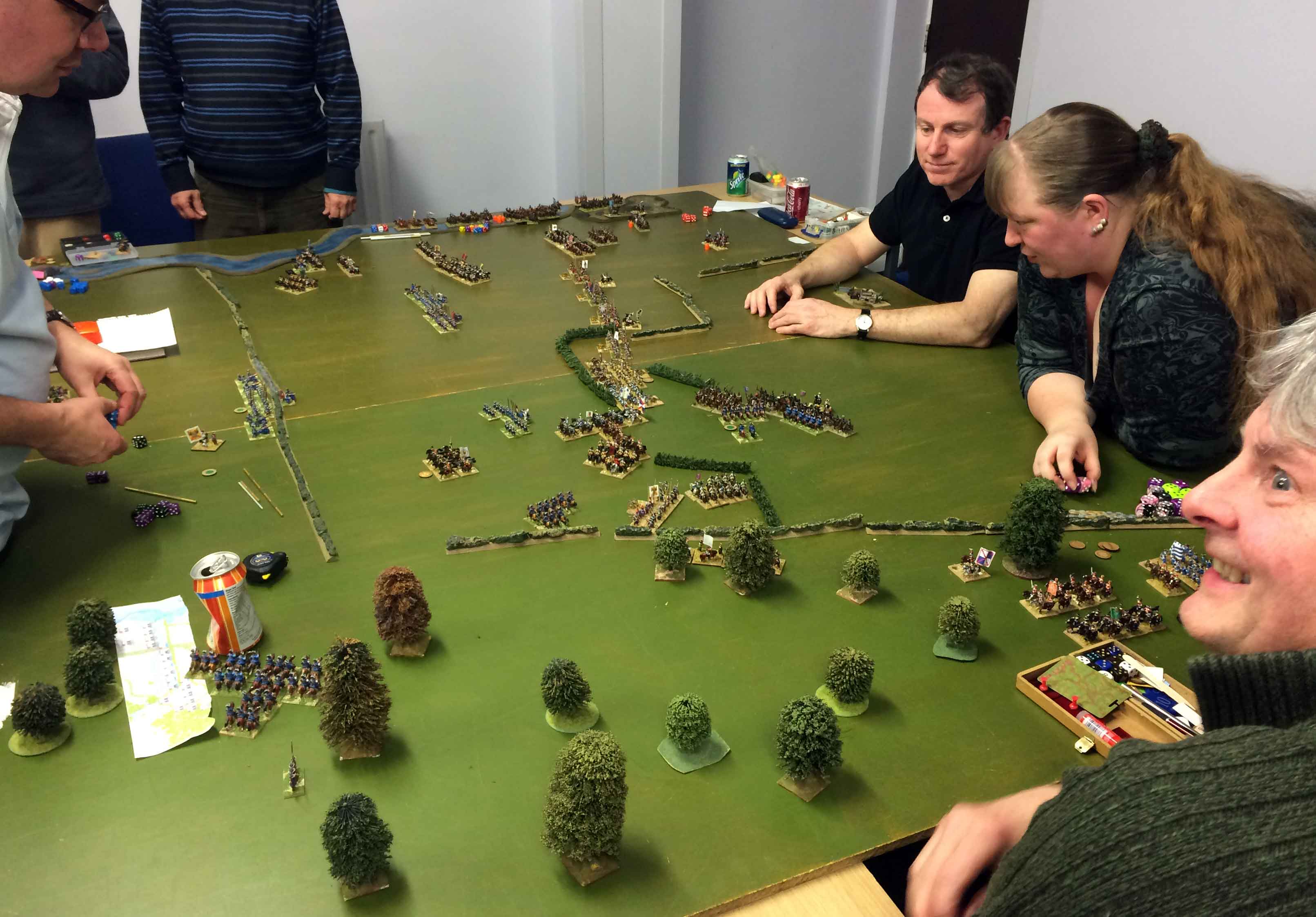
For the club re-fight the terrain and troop deployment was pre-set for the players, based on the historical battle. Steve took command of the Swedish left and Paul the right. On the Allied side Eberstein’s right was taken by Bob and the left by Lynette, and Schack’s right and left by Simon G and Dene respectively. Each command was briefed before battle commenced. The Swedes were informed
that, despite their strong defensive position, a stand-off would be considered a loss; If they were pinned down around Nyborg they would run short of supplies and be forced to surrender. The Allies had two briefings and were asked to act in the spirit of their historical commanders. Bob and Lynette (Eberstein’s command) were therefore committed to battle with the Swedes, with or without Schack’s support. Conversely Dene and Simon (Schack’s command) were asked to avoid battle initially. However they could move up to take Eberstein’s starting positions, and could intervene to cover any disaster or exploit any success. In addition, as Eberstein and Schack hated each other so much, they were told that generals from one command could not take charge or influence troops from the others command.
The Allies had the first move and Eberstein’s command duly advanced their cavalry at speed, even before Schack had fully deployed, and the Swedish cavalry responded with vigorous counter attacks on both wings. The Allied and Swedish centres traded artillery shots, their infantry remaining behind the hedgerows at this stage. On the flanks the rival cavalry crashed into combat. Both sides fielded armoured cuirassiers with pistols (save for a lone unit of Croats on the Allied side), but the Swedes were classed as superior. On the Swedish right their cavalry made steady progress, slowed a little by hedgerows and the presence of Allied infantry. On the Swedish left their cavalry went through the Allied cavalry like a knife through butter. In short order 5 of Eberstein’s cuirassier units were destroyed, their general dead and the Croats and the remaining cuirassier unit in rout. The Swedish cavalry had achieved this for the loss of just one base. Seeing an opportunity to press home their advantage the Swedish infantry advanced In the centre, leaving one unit to defend the guns.
Schack’s command now advanced to steady the Allied position. Their right wing cavalry were understandably wary of taking on the superior Swedish cavalry, but their Dutch infantry (superior with
armoured pike) had no such qualms facing the Swedish infantry (who were only average for this scenario). On the Allied left Schack’s cavalry reinforcements made headway against the now outnumbered Swedish cavalry and they were gradually overwhelmed. With their right wing lost and their infantry losing the battle in the centre the Swedish position was getting desperate. Their victorious and largely intact left wing cavalry could probably have broken through the second Allied cavalry line, but would have been unsupplied as Nyborg would be lost to them. We decided to end the re-fight at this point and assumed the surviving Swedish cavalry (mostly veteran German mercenaries) would take up the offer of enlistment into the Danish army. The scenario outcome was
thus close to the historical outcome, though the Allied breakthrough had been on their left flank rather than their right.
*The Danish Brothers epithet derives from the first Swedish-Danish battle we played at the club. Simon and Dene Green took the Danish command that day and I remarked that‘The Danish Brothers’ was a counter in the boardgame ‘Britannia’. Simon and Dene have subsequently always played on the Danish side in these scenarios. Ironically at Nyborg there were two brothers in command of Danish
units under Schack.
Godendag is a competition that we have been competing in for over 20 years now. It started out as DBM , moving to FoG:AM and now FoG:R. It has become an annual ritual each January, with the weather often proving a trial for attendance. The event is run by Richard Bodley Scott, who is the author of the rules, and is set in rural Wales, just past the Wye Valley before you get to the south coast.
For the club is probably the only event that most people come to, so it is a good chance to take in a few board games, a leisurely pint or two and not forgetting the excitement of the competition.
This Year (2015), we has a winning team – which is a first